The pitch sounds simple: build your AI agent once, deploy it everywhere. WhatsApp, email, phone, webchat — one brain, every channel. And architecturally, that's correct. You should have one behavioral core — one set of playbooks, guidelines, and knowledge — powering your agent across all channels. Maintaining separate agents per channel is an operational nightmare that leads to inconsistent answers and duplicated work.
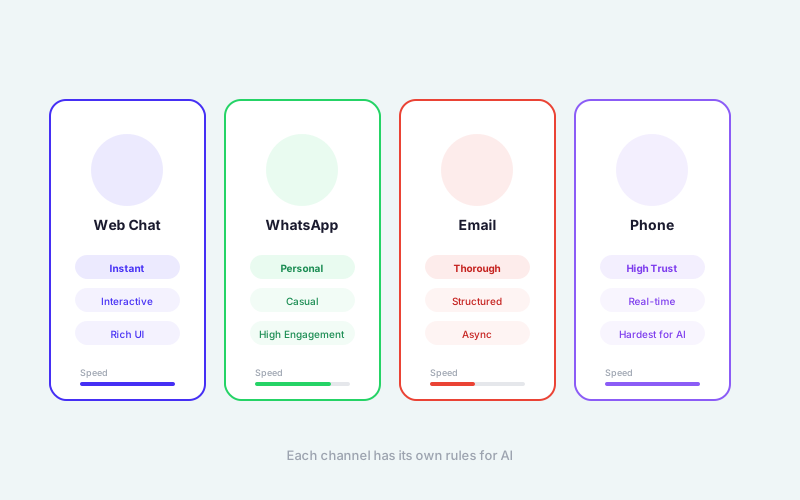
But "one brain" doesn't mean "one behavior." Each channel has its own physics — its own constraints, customer expectations, failure modes, and interaction patterns. An agent that performs beautifully on webchat can be actively annoying on WhatsApp, painfully shallow on email, and awkwardly slow on voice. Same knowledge, same guidelines, same intent — completely different outcomes.
The architecture is shared. The execution can't be.
Webchat: You Have Two Messages
Webchat visitors give you approximately two exchanges before they decide whether to engage or close the widget. That's not a guess — watch your conversation analytics and you'll see the same pattern. Message one from the agent, message one from the visitor, message two from the agent. If value hasn't been delivered by then, the widget closes.
This means your webchat agent can't open with qualifying questions. "What's your name? What company are you with? What brings you here today?" — three questions, zero value delivered, visitor gone. The agent needs to lead with something useful: an answer, a relevant suggestion, a proof point. Qualify after you've earned attention, not before.
Webchat also has a unique advantage: context. You know what page the visitor is on, how they got there, how long they've been browsing. An agent that says "I see you've been looking at the enterprise plan — want me to walk you through how it compares to what you're on now?" is using that context. An agent that says "Hi! How can I help you?" is wasting it.
The behavioral rules for webchat should be aggressive about proactive engagement on high-intent pages (pricing, comparison, contact) and silent on low-intent pages (blog, about). Response length should be short — three sentences max before a natural pause. And the escalation trigger should be fast — if the visitor asks something complex, get a human in quickly rather than attempting a long explanation in a tiny widget.
WhatsApp: Every Message Costs Trust
WhatsApp has a 98% read rate. Every other channel would kill for that number. But it comes with a cost: every message you send that isn't valuable actively damages the relationship. On webchat, a mediocre message gets ignored. On WhatsApp, a mediocre message gets you blocked.
This is personal territory. People use WhatsApp to talk to their family. When a business enters that space, the expectations are different from every other channel. Formal language feels invasive. Long messages feel like spam. Unsolicited follow-ups feel like harassment.
The behavioral rules for WhatsApp need to be fundamentally more conservative than any other channel. Messages should be 2-3 sentences max. The agent should never send two messages in a row without a reply — no "Just following up!" after silence. The tone should be conversational, not professional. And the agent should use media where it makes sense — a product photo or a short video answers a question faster and more naturally than three paragraphs of text.
WhatsApp also has compliance constraints that other channels don't. Template messages for outbound communication. 24-hour conversation windows. Business API rules that change periodically. An agent that doesn't account for these constraints will eventually send a message that gets the business's WhatsApp number flagged or suspended. This isn't hypothetical — it happens regularly to businesses that treat WhatsApp like email.
The highest-performing WhatsApp agents are the ones that say less, not more. Each message is deliberate. Each response directly addresses what the customer asked. No filler, no upsell unless the customer opened the door, no "Is there anything else I can help with?" at the end of every conversation.
Email: Write Like a Human Who Cares
Email is the one channel where customers expect — and actually read — long responses. It's also the channel where AI writing quality is most visible. On chat, a slightly awkward phrase scrolls by. In an email, it sits in the customer's inbox, re-readable, forwardable, screenshot-able.
This is where most AI agents fall on their face. The typical AI email reads like it was generated by an AI: a friendly opening line, a paragraph that restates the customer's question back to them, a generic answer, and a closing that says "Please don't hesitate to reach out if you have any further questions!" Nobody writes like this. Everyone recognizes it instantly.
Good AI emails do what good human emails do: lead with the answer, provide supporting detail, include specific next steps, and end. No restating the question. No filler transitions. No performative politeness. If the customer asked about their refund status, the first line should be "Your refund of $47.50 was processed on March 12 and should appear in your account within 3-5 business days." Not "Thank you for reaching out about your refund. I completely understand how important it is to know the status of your refund, and I'm happy to help you with that."
The behavioral rules for email should prioritize comprehensiveness over brevity — the opposite of WhatsApp. If a customer asks three questions, answer all three, clearly delineated. Attach relevant documents rather than describing them. Format with headers and bullet points when the response has multiple parts. And invest heavily in the prompt engineering for email specifically — the writing quality bar is much higher than on any other channel.
Email also has a unique advantage for complex issues: asynchronous thinking time. The agent doesn't need to respond in 2 seconds. It can take the time to search the knowledge base thoroughly, check multiple sources, and compose a comprehensive response. Use that. An email that arrives in 30 seconds with a shallow answer is worse than one that arrives in 2 minutes with a thorough one.
Voice: Be Honest About What Works
Here's the uncomfortable truth about AI voice: it's the least mature channel, and most of what gets demo'd doesn't survive contact with real callers.
The fundamental constraint is latency. In a chat, a 2-second delay between messages is normal. On a phone call, a 2-second pause feels like the line went dead. The caller says "Hello?" The agent hasn't responded yet because it's still processing. Now the caller says "Hello?" again, and the agent tries to respond to both, creating a confused overlap. The call quality degrades fast.
Sub-500ms response latency is the threshold for natural-feeling voice interaction. Achieving this while also searching a knowledge base, evaluating behavioral guidelines, and generating a response is architecturally difficult. Most voice AI platforms achieve it by limiting what the agent can do — simple, scripted interactions with predictable flows.
And that's where voice AI actually works well today: structured interactions. Appointment booking. Order status checks. Call routing and triage. After-hours coverage for common questions. These are high-value use cases with real ROI — they just aren't the open-ended conversational AI that gets demo'd on stage.
What doesn't work: open-ended problem-solving calls where the customer needs to explain a complex situation. Frustrated callers who need empathy and flexibility. Calls with background noise, accents, or multiple speakers. Anything requiring the agent to say "let me look that up" and make the caller wait in silence.
The honest positioning for voice AI right now is: it's excellent for high-volume, structured interactions that free up human agents for complex calls. That's a real, valuable use case. Selling it as a replacement for your best phone support rep is setting everyone up for failure.
The behavioral rules for voice should be the most conservative of any channel. Short sentences. Simple vocabulary. Frequent confirmation ("I've booked that for Thursday at 2pm — does that sound right?"). And aggressive escalation to a human for anything outside the agent's structured flows — with a warm transfer, not a cold dump into a queue.
One Brain, Channel-Aware Execution
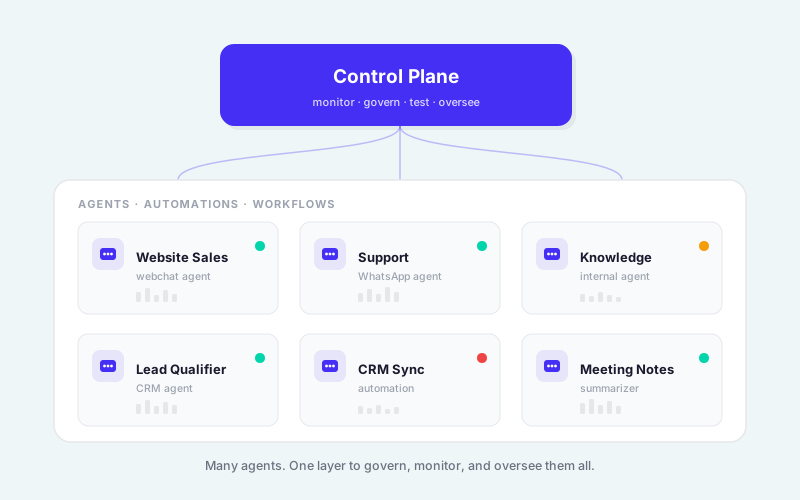
The right architecture is a shared behavioral core — one set of guidelines, one knowledge base, one set of tools — with channel-specific rules layered on top.
The guideline "if the customer asks about pricing, provide the current plan comparison" applies everywhere. But how it's delivered differs: a detailed comparison table in email, a brief summary with a link in webchat, a two-sentence overview on WhatsApp, a scripted walkthrough on voice.
This means your behavioral design needs to account for channel as a variable. Some guidelines might only apply on certain channels — a proactive engagement rule that makes sense on webchat would be invasive on WhatsApp. Composition rules might differ — canned responses for voice (where consistency and brevity are critical) and fluid responses for email (where the agent needs to write naturally at length). Escalation thresholds might vary — faster to escalate on voice where silence is deadly, more patient on email where the customer isn't waiting in real-time.
This is another layer of complexity that most businesses don't anticipate. "Deploy on WhatsApp" sounds like flipping a switch. In practice, it's a channel strategy project: adapting behavioral rules, tuning response patterns, testing across scenarios, and monitoring performance independently per channel.
One brain. Four different disciplines. Get any of them wrong and the agent looks broken — even when the underlying intelligence is excellent.