Your Medusa store has product, customer, and order data. With NForce, an AI agent can use all of it — answering customer questions, helping shoppers find what they're looking for, running outreach, surveying buyers — across every channel your customers use. The integration is live now.
The honest problem
Most chatbots bolted onto Medusa stores have the same problem: they don't know your store. They can answer "what's your return policy?" from a help-desk article, but they can't tell a customer where their order is, whether the size they want is back in stock, or what they bought last time. The moment a real question lands, they escalate. You bought an agent and ended up with another routing layer.
What you can build
When the agent has full access to your store and the channels your customers use, the surface area expands fast. Some of what NForce + Medusa makes possible:
- Customer support — Order status, returns, product Q&A, shipping ETAs. Table stakes, but answered from live data, not a stale doc.
- Conversational product discovery — Customers describe what they want in plain language; the agent recommends real products from your catalog with prices, availability, and reasoning. Useful for gift shopping, complex SKUs, or any catalog too big to browse.
- Post-purchase satisfaction — Automatic follow-up a few days after delivery. Open-ended or NPS-style, results synced back to your CRM.
- Restock outreach — When an item a customer asked about (or viewed) comes back in stock, reach out on their preferred channel.
- New product launches — Segment customers by purchase history and announce relevant drops via email or WhatsApp.
- Promo campaigns — Targeted outreach for sales, with the agent handling inbound questions inline.
- Win-back — Lapsed customer outreach tied to actual order history, not generic schedules.
All of these run on the same agent, with the same Medusa data, across the same channels. You're not buying a chatbot. You're buying a customer engagement layer for your store.
What that looks like in practice
A customer lands on your storefront looking for a gift. They open the chat: "I need a birthday present for my dad, he's into woodworking, budget around $150."
The agent asks one clarifying question — "does he already have a set of chisels, or is this his first?" — then recommends three options from your catalog. Each with a price, an image, and a one-line reason it fits. The customer picks one, asks "does it ship gift-wrapped?", the agent confirms it does, with a free card, and walks them to checkout.
No category menus. No search-then-filter-then-scroll. No abandoned tab three minutes later. Just a conversation with someone who knows the store.
Now do that for every visitor, on every channel, in any language they speak.
Why this actually works
Behavior like that is easy to describe and hard to ship. Here's what makes it real:
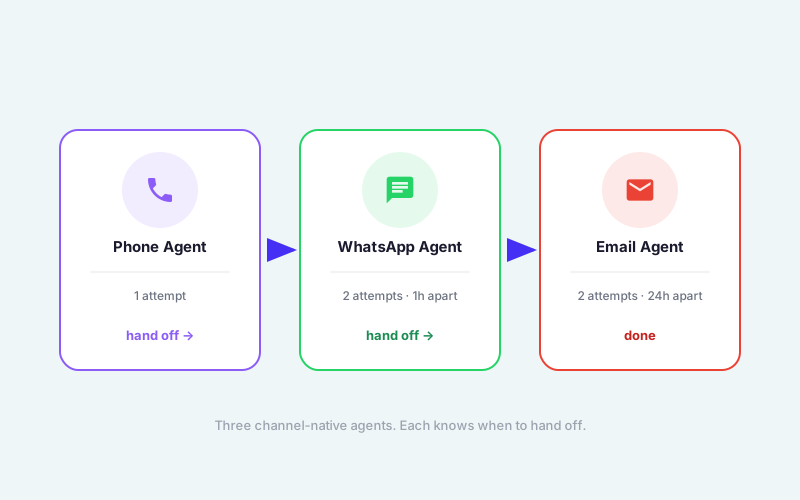
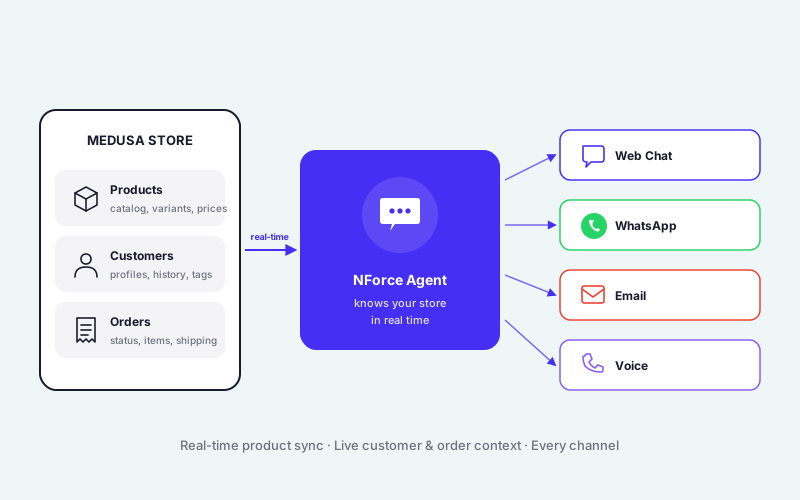
- Multi-channel from one agent. The same agent handles webchat on your storefront, email replies, WhatsApp threads, and inbound voice calls. One configuration, every channel.
- Layered knowledge. Your Medusa catalog is one knowledge source. NForce lets you layer in shipping policies, return processes, warranty terms, and FAQs from PDFs, Notion, or Google Drive — all hybrid-searchable, all available to the agent in the same query.
- CRM sync. Cross-reference Medusa orders with your HubSpot, Salesforce, or Zoho data. The agent knows whether the customer it's talking to is a first-time buyer or a five-time VIP, and adjusts.
- Reliability you can verify. Every NForce agent ships with a test suite covering your hardest scenarios — refund requests, stock disputes, edge cases specific to your business. We re-run the suite every time the agent's behavior changes, so you know what improved and what regressed before customers find out.
- Conversation monitoring and analytics. Every conversation gets auto-classified with smart tags. Dashboards show volume, escalation rates, KPI movement, and which paths drive results. You see what's working without reading every transcript.
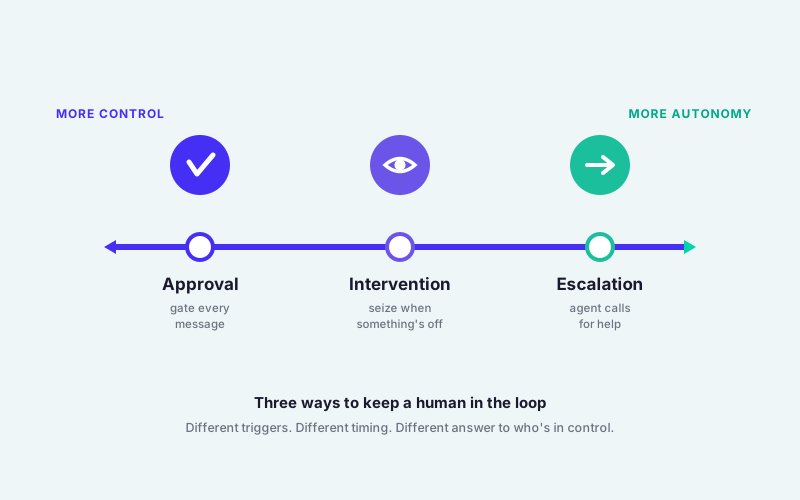
- Human escalation. When the agent hits its limits — a refund outside policy, a sensitive complaint — it hands off to your team with full context, not a cold transcript dump.
The Medusa integration
On the Medusa side, the integration is built as a v2 plugin. Once installed in your store, it pushes product changes to NForce in real time — no nightly cron, no stale catalog. When you create or update a product, the agent knows within seconds. When you delete one, it's gone from the agent's knowledge immediately.
You control what syncs. A field mask in the plugin admin lets you choose which product fields, relations, and custom modules flow to NForce — useful for stores with sensitive metadata you'd rather keep internal.
Beyond products, the plugin exposes admin endpoints for customer search, order lookup, and order detail — what NForce agents use to answer order-status questions live, look up a customer by email or phone, or pull the line items from an order they're discussing.
It's push-based, scoped, and built to stay out of the way.
Getting started
NForce is currently white-glove. To get your Medusa store wired up, book a demo and we'll show you the agent in action — answering questions against your real catalog, running one of the use cases above on a test customer, and seeded with the edge cases specific to your business.