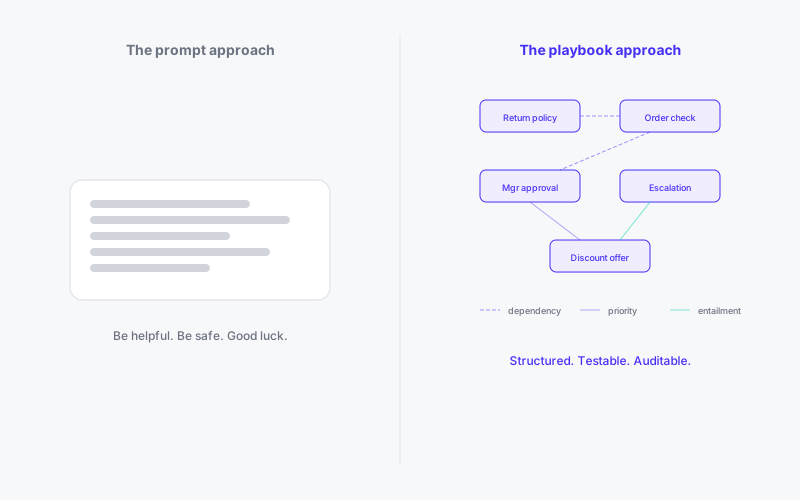
Here's how most AI agent platforms work: you write a prompt. Something like "You are a helpful customer support agent for Acme Corp. Be friendly. Don't discuss competitors. If you don't know the answer, escalate to a human." Then you deploy it and pray.
It works for the demo. The agent sounds great when you ask it a softball question. Then a real customer shows up with a real problem, and the agent gives a confident answer that violates your return policy, offers a discount it wasn't authorized to give, and tells the customer to call a phone number that was disconnected six months ago.
The prompt said "be helpful." The agent was being helpful. It just didn't know what the rules were because nobody encoded them. A five-sentence prompt is not a behavioral specification. It's a vibe.
Rules, Not Vibes
The alternative to prompt-and-pray is structured behavioral design. Instead of writing a paragraph of instructions, you define explicit rules: condition-action pairs that tell the agent exactly what to do in specific situations.
A guideline has a condition ("the customer is asking about returning a product and the order is more than 30 days old") and an action ("explain that the standard return window has closed, but offer to connect them with a manager who can review exceptions"). This is precise. It's testable. It's auditable. And crucially, it doesn't depend on the language model interpreting a vague instruction correctly.
Each guideline also has a criticality level. A compliance rule ("never share internal pricing tiers with customers") is high criticality, meaning the engine treats it as mandatory in every relevant context. A nice-to-have ("suggest related products when the conversation is wrapping up") is low criticality, meaning the engine considers it but won't force it into an interaction where it doesn't fit.
Twenty guidelines is a simple agent. Fifty is a well-specified one. A hundred or more is an enterprise deployment covering dozens of conversation types with nuanced behavioral constraints. At that scale, the guidelines aren't a list. They're a system. And systems have interactions.
The Interaction Problem
Here's where the prompt approach falls apart completely. When you have a list of rules, some of them interact. And those interactions determine behavior far more than any individual rule does.
Dependencies
Some guidelines only make sense if another guideline is also active. "Offer the loyalty discount" only applies if "verify the customer's account status" has already fired. If the account check didn't happen (maybe the customer hasn't identified themselves yet), the discount offer shouldn't be available. That's a dependency: guideline A requires guideline B.
In a prompt, this is expressed as a paragraph of conditional logic that the language model may or may not follow. In a structured system, it's a directed edge in a graph. The resolution engine checks: is the dependency satisfied? If not, the guideline is filtered out. No ambiguity, no hoping the model reads the paragraph correctly.
Priorities
Some guidelines conflict. "Upsell the premium plan when the customer mentions scaling" and "Acknowledge the customer's budget concerns before making recommendations" can both be relevant in the same conversation. Which one wins?
In a prompt, you write "balance upselling with sensitivity to budget" and hope the model figures it out. Sometimes it does. Sometimes it leads with the upsell and the customer feels pressured. Sometimes it's so cautious about budget that it never mentions the premium plan.
In a structured system, you define a priority relationship: "budget sensitivity has priority over upselling." When both guidelines match, the engine deactivates the upsell guideline. The budget-sensitive response gets generated. The behavior is consistent every time, not dependent on how the model interprets "balance."
Entailment
Some guidelines should activate other guidelines. "If the customer mentions they're considering canceling" should automatically trigger "review the customer's account history for retention opportunities" and "check eligibility for the win-back offer." These aren't separate rules that happen to fire together. They're causally linked: the first implies the others.
Entailment relationships make this explicit. When guideline A fires, guidelines B and C are automatically added to the active set. This creates behavioral chains that are predictable and auditable, not emergent properties of prompt interpretation.
Three Iterations to Stability
The resolution engine doesn't just apply these relationships once. It runs up to three iterations to reach a stable state, because each resolution step can change the active set of guidelines.
Iteration 1: Match guidelines against the conversation context. Filter by dependencies (remove guidelines with unmet dependencies). Apply priorities (remove deprioritized guidelines). Resolve entailments (add newly activated guidelines).
Iteration 2: The new guidelines added by entailment might have their own dependencies and priorities. Re-evaluate. Filter, prioritize, entail again.
Iteration 3: Check for convergence. If the active set hasn't changed, the resolution is stable. If it has, one more pass. After three iterations, the engine uses whatever state it's reached.
This is a graph traversal algorithm, not a prompt. Dependencies are precondition edges. Priorities are conflict-resolution edges. Entailments are forward-propagation edges. The "behavior" of the agent is the stable state of this graph after resolution. No amount of prompt engineering can replicate this because prompts don't have the machinery to express formal relationships between rules.
Journeys: Behavior Over Time
Single-turn guidelines handle individual moments. Journeys handle conversations that unfold over multiple turns with branching paths.
A lead qualification journey might look like this: the agent greets the customer and asks an opening question. Based on the response, it branches: if the customer mentions a specific product, it goes down the product-interest path. If the customer mentions a general need, it goes down the needs-discovery path. Each path has its own stages, with behavioral rules at each stage.
Journeys are graphs too: nodes (stages) connected by edges (transitions with conditions). Each node can define its own action, available tools, and composition mode (should the agent generate a fluid response, use a canned template, or a hybrid?). Each edge has a condition that determines when the transition fires.
The clever part is that journey nodes get projected into synthetic guidelines during resolution. This means the same graph resolution engine that handles standalone guidelines also handles journey logic. Dependencies, priorities, and entailments work across both. A standalone guideline can depend on a journey stage. A journey transition can be prioritized over a conflicting guideline. The system is unified.
Inheritance and Scoping
Real deployments have multiple agents with overlapping but distinct behaviors. A sales agent and a support agent share company policies but have different conversation strategies. A senior-tier support agent has all the behaviors of a standard agent plus authorization to offer higher discounts.
Playbook inheritance handles this. A parent playbook defines shared behaviors (company policies, brand voice, universal guardrails). A child playbook inherits everything from the parent and adds or overrides specific rules. A grandchild can inherit from the child and further specialize.
Selective disabling lets child playbooks turn off inherited rules that don't apply. The enterprise support playbook might disable the "suggest self-service portal" guideline that makes sense for standard support but is inappropriate for premium customers.
Tag-based scoping controls which guidelines belong to which playbook. A guideline tagged with "playbook:sales" only appears in the sales playbook's resolution. An untagged guideline is global, available to every playbook in the tenant. This gives you modular, composable behavioral design without duplication.
Version Control for Behavior
Every change to the behavioral graph is a potential regression. Adding a guideline might conflict with existing rules through dependency chains you didn't trace. Removing one might break an entailment chain. Modifying a criticality level might change which guidelines survive priority resolution.
This is why behavioral version control matters. The live editing environment (preview) lets you make changes freely without affecting the production agent. When you're satisfied, you release: the entire behavioral graph gets snapshotted as a version. Guidelines, relationships, journeys, terms, canned responses, context variables, all of it, frozen.
The released version is what the agent uses in production. It's immutable. Every conversation that uses this version gets the exact same behavioral graph. This means you can compare agent performance across versions, identify which version introduced a regression, and roll back to a known-good state instantly.
The snapshot stores both the resolved graph (optimized for runtime, with indices instead of IDs) and the source data (original entity states for audit and revert). This dual storage means you can restore the preview environment to any historical version's exact state, not just view what it was, but actually revert to it.
Why This Matters
A prompt is a suggestion. A playbook is a specification.
When a customer asks your agent about returns, a prompt-based agent generates whatever the language model thinks "be helpful and follow the return policy" means today. A playbook-based agent activates the specific return-policy guideline, checks its dependencies (is the order verified?), applies priorities (does a compliance rule override the standard response?), resolves entailments (should the satisfaction survey guideline also activate?), and generates a response constrained by the resulting behavioral graph.
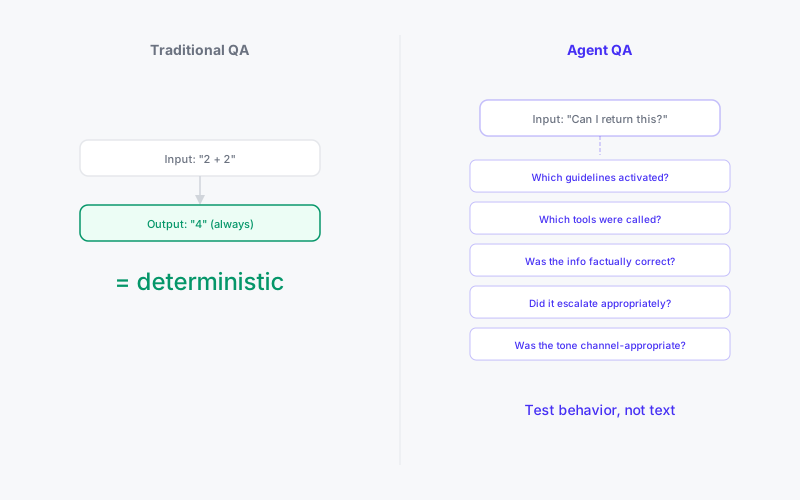
The first approach works until it doesn't, and when it fails, you don't know why. The second approach is auditable (you can trace exactly which guidelines fired), testable (you can verify the resolution produces the right active set), and versionable (you can compare, roll back, and iterate with confidence).
The agents that businesses will trust with their customers are the ones governed by structured behavioral design, not the ones running on a paragraph of good intentions. The consultants who can design these systems are building a practice on substance, not hype.