A lead comes in. You call. No answer. Now what?
Every go-to-market team has opinions about what should happen next. WhatsApp them — it has a 98% read rate. No wait, email first, it's less invasive. Actually, just drop them back into the nurture sequence and let drip campaigns handle it. No, assign it to an SDR for manual follow-up. No, send a templated LinkedIn message. Everyone has a theory. Almost nobody has a system.
This is the holy grail of inbound: multi-touch follow-up that actually adapts to what the lead does, sequences across channels, and never gives up until you've genuinely exhausted the reasonable paths. Every sales team wants it. Almost nobody has it. And the reason isn't effort or intent — it's that most teams are trying to solve it with the wrong category of tool.
What Most Teams Actually Do
Here's the common reality. A lead submits a demo request. The SDR makes one attempt — a call or a template email — and moves on. Maybe there's a follow-up three days later if someone remembers. Maybe there's a drip campaign in HubSpot that fires three generic emails on day 0, day 3, and day 7. That's it. One or two touches, all on one or two channels, with zero awareness of whether the lead opened anything, read anything, or did anything. If the lead doesn't respond, they're quietly reclassified as "cold" and the team moves to the next one.
Watch the analytics on this pattern and you'll see the same thing every time: conversion rate sits around 3-7% for inbound demo requests, and everyone assumes the problem is lead quality. It isn't. The problem is execution. The teams that reach 15-25% conversion on the same lead quality aren't using better targeting or better copy — they're doing genuine multi-touch follow-up, and they're closing leads that the others gave away.
Why Stitching Tools Doesn't Solve This
The obvious move is to wire it together. Chili Piper handles the instant routing and booking. HubSpot runs the email sequences and stores the CRM record. n8n orchestrates the WhatsApp send when someone doesn't answer. Zapier fires the trigger when the call goes to voicemail. This is what most teams try. And it almost works — until you actually run it.
The failure mode is always the same: you end up with workflow steps, not agents.
A HubSpot email template is a workflow step. It fires when a condition is met, inserts merge fields, and sends the same body to everyone in the segment. It isn't writing. An n8n branch that sends a WhatsApp message is a workflow step. It takes the inbound form data, maps it into a template, and hits the WhatsApp Business API. It isn't having a conversation. A Zapier trigger that assigns a lead to an SDR is a workflow step. It doesn't know whether the lead wants to be called, whether this is the third time you've tried, or whether the last message you sent is still sitting in their WhatsApp unread.
Workflow steps can fire on a schedule. They can branch on a field. What they can't do is write a message, pick a moment, or make a judgment call. And multi-touch follow-up — the real kind that converts — is mostly those three things.
The result is a sequence that looks multi-touch on paper and feels hollow to the lead. Generic copy. Mechanical timing. No sense that anyone is paying attention. The lead correctly concludes: these people aren't paying attention, so why should I pay attention to them?
The Alternative: Channel-Native Agents That Hand Off
The architecture that actually works is this: one AI agent per channel, each one native to its medium, with explicit handoffs between them when a channel is exhausted.
The phone agent is a phone agent. It knows how to talk on the phone — timing, cadence, voicemail length, when to pause, when to push, when to wrap up. Its playbook is written for voice: short sentences, conversational vocabulary, one idea per breath. Its only job is to call the lead and see if it can reach them.
The WhatsApp agent is a WhatsApp agent. It writes for WhatsApp — two-sentence messages, casual tone, no formal openers, no "Hi, I hope this finds you well." Its playbook governs timing for a personal channel: no double-messaging without a reply in between, conservative follow-up cadence, no spam.
The email agent is an email agent. Its playbook is entirely different — comprehensive, structured, written in full paragraphs, respectful of inbox real estate. Its timing is patient because email is patient.
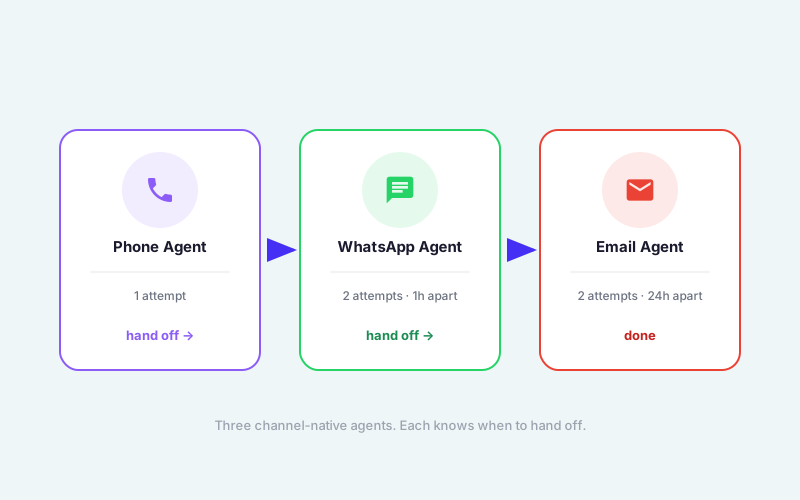
And the orchestration between them is a handoff. When the phone agent decides it's done what it can do, it hands the lead off to the WhatsApp agent. When the WhatsApp agent decides it's done what it can do, it hands off to the email agent. When the email agent decides it's done, the sequence stops. No central conductor firing cron jobs. No workflow engine checking statuses. Three specialists, each running its own channel, each responsible for handing off cleanly when its part of the job is done.
This is a fundamentally different shape from a workflow. A workflow has steps that execute. A handoff chain has actors that act, finish their turn, and pass the baton.
How We Run It on Our Own Book-a-Demo Form
We got tired of explaining this in sales conversations, so we built it on ourselves. When a lead submits the "Book a Demo" form on nforce.ai, a phone agent picks up the conversation. If it can't reach them, it hands off to a WhatsApp agent. If the WhatsApp agent can't reach them, it hands off to an email agent. If the email agent can't reach them, we leave them be. Three agents. Two handoffs. A handful of touches spread across a couple of days. Here's what that actually looks like.
The phone agent goes first. As soon as the form comes in, the phone agent calls the lead. One attempt — a real phone call, a real voice on the other end, a short intro that references what brought them in. If the lead picks up, great: the agent handles the conversation and books a slot. If they don't pick up, the agent leaves a short voicemail and marks the phone attempt as exhausted. It doesn't call again. It hands off.
The WhatsApp agent picks up the baton. The WhatsApp agent gets the handoff and sends a short message. Two sentences. Conversational. No pressure. "Hey — tried giving you a call, happy to chat here if that's easier." Then it waits. If the lead replies, the WhatsApp agent handles the conversation from there and books a meeting. If the lead doesn't reply, the WhatsApp agent waits about an hour and tries once more with a different angle — usually a single specific question that's easier to answer than an open-ended one. Still no reply? The WhatsApp agent marks itself as exhausted and hands off.
The email agent takes the final leg. The email agent gets the handoff and sends an email. Unlike WhatsApp, email gives it room to be thorough — a real subject line, a full paragraph or two, a clear call to action. If the lead replies, the email agent carries the conversation. If they don't, the email agent waits 24 hours and sends one follow-up — a different angle, no "just checking in" filler. Still no reply? The email agent marks the sequence as exhausted, and we leave the lead alone.
What happens when the lead replies "not right now"? One of the most common real-world responses isn't a yes or a no — it's "thanks, interesting, but not a good time, can you reach out next week?" A workflow engine has nothing useful to do with that. A scheduled sequence either keeps firing on autopilot (annoying) or gets manually paused by an SDR who remembers to handle it (unreliable). An agent just… handles it. If the WhatsApp agent gets a reply like that, it acknowledges the ask, updates its own next-action to the day the lead specified, and then gets out of the way until then. No further touches in the meantime. No handoff to email "just in case." The lead said "next week," so the agent means next week. Try writing that logic as a Zapier trigger.
Across all of this — one phone call, two WhatsApp messages, two emails, three different agents — the lead has been reached through every reasonable channel inside a couple of days. If they were going to engage, they've had every opportunity to. If they weren't, we haven't spammed them into the ground. And if they engaged on their own terms — "not now, try next week" — the agent adapts instead of steamrolling. None of it requires anyone stitching tools together by hand.
Why Each Agent Is a Specialist, Not a Worker
The reason this beats workflow-based sequencing has less to do with the handoff mechanics and more to do with what each agent actually is.
A phone agent isn't a cron job that dials a number. It's a voice-native agent with a playbook written for phone conversations. It knows how long a voicemail should be (about fifteen seconds), how to open one (state the reason in the first sentence), how to close one (leave a specific callback ask, not "give me a call when you can"). It knows what to do if the lead picks up mid-voicemail. It knows how to handle the "can you hear me now" moments. None of this lives in a workflow engine. It lives in the agent.
A WhatsApp agent isn't an API call wrapped in a retry loop. It's a text agent with a playbook written for a personal messaging channel. It knows to keep messages short. It knows not to send two messages in a row without a reply. It knows how to use emoji without being weird about it. It knows how to reference the fact that a phone call just happened without making it awkward. It knows the difference between a nudge and pressure. These are behavioral rules, not workflow conditions.
An email agent isn't a template with merge fields. It's a writing agent. It takes the actual content of the form submission and composes a real response to it. It adapts subject lines to the specific pain point the lead described. It writes in paragraphs because email is a paragraph medium. It skips "just following up" openers because they signal automated nothingness.
Each agent is channel-native, which means each agent is good at its channel in a way that a single cross-channel template can never be. That's the whole point. You're not splitting the work across channels because you have to — you're splitting it because each channel deserves its own specialist, and the handoffs are how you chain them together.
What We Haven't Done Yet (And Probably Will)
The honest version of this story includes one thing we haven't done yet. The three agents in our book-a-demo flow don't share memory. The WhatsApp agent doesn't read the phone agent's internal notes. The email agent doesn't know exactly what the WhatsApp agent tried. Each agent operates on the handoff payload it receives — lead profile, history of previous attempts, status — and runs its own play from there.
This works well. It's simpler than shared memory, it's what we built for our own inbound, and it still dramatically outperforms a stitched workflow because each agent is a channel specialist making judgment calls inside its own domain.
Could we layer shared memory on top of this? Yes. nForce supports it — agents can share persistent context across conversations, and some of our customers already use it for workflows where one agent needs to remember things another agent learned. We just haven't applied it to our own book-a-demo flow yet, because the handoff architecture alone was producing follow-up miles ahead of what most teams do, and we wanted to see how far that got us on its own. Shared memory is on the roadmap for our own inbound, and when we add it the agents will start referencing each other's touches more explicitly and the whole thing will tighten up. But even without it, the handoff version is already a step change — which is itself a useful data point: the architectural shift from workflow-as-steps to agents-handing-off is where most of the win comes from. Shared memory is a refinement on top.
The Uncomfortable Truth About Lost Leads
Most teams that complain about lead quality don't actually have a lead quality problem. They have a follow-up execution problem. And the reason they don't see it is that their follow-up is invisible to them — it happens (or doesn't) across disconnected tools, and nobody has a single view of what was actually tried, what was ignored, or what was never attempted at all.
If someone filled out your demo form and you made one call, sent one email, and gave up — you didn't lose the lead. You gave it away. That's a hard thing to hear, and it's true. The teams that win inbound are the ones that exhaust every reasonable path to reach a lead who showed genuine intent. Not spam — genuine, thoughtful, adaptive outreach that respects the lead while refusing to let them fall through the cracks.
The reason most teams can't do this isn't budget or intent or even effort. It's architecture. They're trying to stitch together a sequence of workflow steps, and workflow steps don't know how to write messages or make judgment calls. What actually works is agents — channel-native agents, each one good at its medium, handing off cleanly when its part of the job is done.
We built nForce because this gap was obvious and nobody was filling it. And we dogfood it on our own inbound because — if we weren't willing to run our own demo pipeline on it, why would we ask anyone else to?
If you're watching leads go cold and wondering whether it's lead quality, look at your follow-up first. The answer is almost never what you think it is. And the architecture that actually solves it is probably not the one you're using.