The AI industry spent the last two years convincing everyone that deploying agents is easy. Point, click, prompt, done. Every platform shows the same demo: the agent answers a question, sounds impressive, and everyone in the room nods along.
Then they try to put it in front of real customers. And everything falls apart.
Not because the AI is bad. Because nobody in the room understood what it actually takes to run an autonomous system that talks to humans, takes actions, and represents your business — across channels, at scale, around the clock.
That gap — between the demo and reality — is creating an entirely new category of expert. And it's one of the biggest professional opportunities in tech right now.
The Demo Trap
A demo handles one happy path. Production handles ten thousand edge cases simultaneously.
In the demo, the customer asks a clean question. The agent pulls the right information. It responds perfectly. Everyone applauds. But production customers don't ask clean questions. They ramble. They're frustrated. They ask about three things at once. They reference a conversation from last week. They try to negotiate. They lie. They send voice notes in one language and expect a reply in another.
The moment an agent talks to real customers on real channels with real money on the line, everything changes. Tone, accuracy, timing, escalation, compliance, and brand safety all have to work simultaneously. A wrong answer isn't a demo hiccup — it's a screenshot on social media.
Most companies try to self-serve. They spend a few weeks tweaking prompts, realize they're playing whack-a-mole with edge cases, and either abandon the project entirely or arrive at the conclusion they need someone who actually understands the layers.
The Layers Nobody Talks About
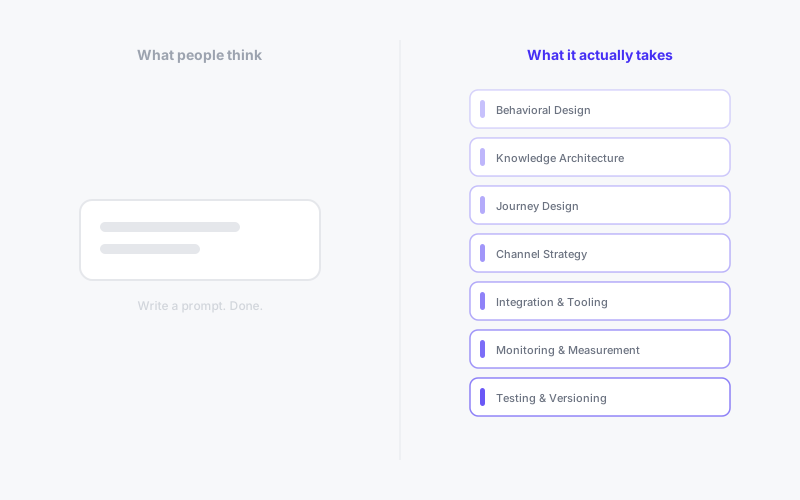
Here's what people miss: a production agentic system isn't one thing. It's a stack of interdependent layers, each of which is a discipline unto itself. Getting any one of them wrong degrades the entire system. Getting several of them wrong makes the agent actively harmful to the business.
Behavioral Design
You're not writing prompts. You're designing behavioral policy for an autonomous entity that represents your business.
This means structured rules: if the customer is asking about pricing and hasn't been qualified yet, do X. If the customer mentions a competitor, do Y. If the customer is upset and has been waiting more than 24 hours, do Z — but only if the previous rule about escalation thresholds hasn't already fired.
These rules interact with each other. Some depend on others — you can't offer a discount unless the agent has first confirmed the customer's account status. Some override others — a compliance rule about data handling trumps a sales-oriented upsell guideline. Some are only relevant when another fires first — an entailment relationship where guideline A triggering means guideline B should also be considered.
This isn't a prompt. It's a directed graph of behavioral constraints with dependency chains, priority hierarchies, and conditional activation. Getting it wrong means the agent contradicts itself, gives unauthorized discounts, makes promises the business can't keep, or handles a sensitive situation with the wrong tone.
Getting it right requires someone who understands both the business logic and the interaction dynamics well enough to encode them as composable, testable rules.
Knowledge Architecture
What the agent knows is as important as how it behaves. And "just upload your docs" is about as useful as telling someone to "just learn the internet."
Knowledge architecture means deciding how information gets structured, chunked, embedded, and ranked so the agent retrieves exactly the right piece at exactly the right moment. It means managing multiple sources — product documentation, support articles, policy PDFs, website content, CRM data — and keeping them in sync, deduplicated, and current.
It means understanding that a 50-page product manual needs to be broken into semantically meaningful chunks with contextual headers, not just split every 500 tokens. It means knowing that hybrid search — combining semantic similarity with keyword matching and reranking — dramatically outperforms naive vector search.
Bad knowledge architecture produces the most dangerous failure mode in AI: confidently wrong answers. The agent sounds certain because it found something. It just found the wrong thing. And the customer believed it.
Journey Design
Real customer interactions aren't single-turn Q&A. They're multi-step journeys with branching paths, conditional logic, and consequential decisions at each node.
A lead qualification journey might start with a greeting, move through needs discovery, branch based on budget range, include a product recommendation with specific composition rules (does the agent use its own words or a canned response?), handle objections, and either book a meeting or gracefully exit. Each step has its own behavioral rules, available tools, and tone considerations.
Designing these requires understanding both the business process and the conversational dynamics — when to be proactive, when to wait, when to push, when to back off, when to bring a human in. It's closer to service design than software engineering.
Channel Strategy
An agent on WhatsApp is not the same as an agent on email. The tone is different. The message length is different. The timing expectations are different. The media capabilities are different. The compliance rules are different.
WhatsApp demands short, conversational messages with a 98% read rate that makes every bad message costly. Email allows depth but requires polished writing quality. Voice requires sub-500ms response latency or the caller thinks the line went dead. Web chat has the shortest attention span — if the agent doesn't deliver value in two exchanges, the visitor closes the widget.
Most businesses deploy identical logic across every channel and are baffled when results vary wildly. An expert knows that each channel is its own discipline with its own rules, and adapts the behavioral design, tone, and response strategy accordingly.
Integration and Tooling
An agent that can only talk is a liability. The value comes from agents that can take action — look up an order, check calendar availability, update a CRM record, create a support ticket, send a follow-up email, retrieve a document, process a return.
Each integration has its own authentication model, data structure, error modes, and rate limits. Wiring them up correctly is specialized work. But the harder problem is configuring when the agent should use each tool. A calendar booking tool is useless if the agent offers to schedule a meeting before confirming the prospect is actually qualified. An order lookup tool is dangerous if the agent uses it to surface information the customer shouldn't see.
Tool configuration is behavioral design's sibling: which tools are available in which contexts, under which conditions, with which guardrails.
Monitoring and Measurement
You can't manage what you can't see. Production agents need real-time monitoring: conversation classification, performance KPIs, resolution tracking, revenue attribution, and anomaly detection.
But collecting data is the easy part. Interpreting it is where expertise matters. A drop in resolution rate could be a knowledge gap, a guideline conflict, a channel mismatch, a tool failure, or a seasonal shift in customer intent. Diagnosis requires understanding all the layers and knowing which one to investigate first.
The expert doesn't just build dashboards — they read them like a diagnostic instrument and know which levers to pull.
Testing and Versioning
Every change to behavior, knowledge, or tooling can break something else. Add a new guideline and it might conflict with three existing ones. Update the knowledge base and the agent might start giving different answers to questions that were working fine. Change a tool configuration and an entire journey might derail.
Production agentic systems need test suites, regression testing, draft modes, and version control. You need to preview changes before they go live, roll back bad releases without disrupting active conversations, and maintain an audit trail of what changed and why.
This is operational discipline that most businesses have never needed before. It's not glamorous work. But it's the difference between an agent that improves over time and one that degrades with every well-intentioned edit.
Why Business Users Won't Do This
This isn't a knock on business users. They shouldn't have to think about guideline dependency graphs or embedding strategies or regression test coverage. They have businesses to run.
The platform can be user-friendly. The discipline of using it well is what requires expertise. These are different things, and conflating them is how projects fail.
WordPress is user-friendly. Anyone can install a theme and write a blog post. But running a high-traffic, SEO-optimized, conversion-focused website that actually drives business results? That takes a specialist. The tool is accessible. The craft is not.
The same dynamic is playing out with agentic systems right now. The platforms are getting easier to use. The work of deploying, governing, and optimizing agents that handle real customer interactions responsibly and effectively? That's getting more complex, not less, as capabilities expand and stakes increase.
Businesses will adopt agentic platforms. But they'll hire experts to run them — just like they hired consultants for every other enterprise platform before this one.
The Emerging Practice
This isn't a prediction. It's already happening.
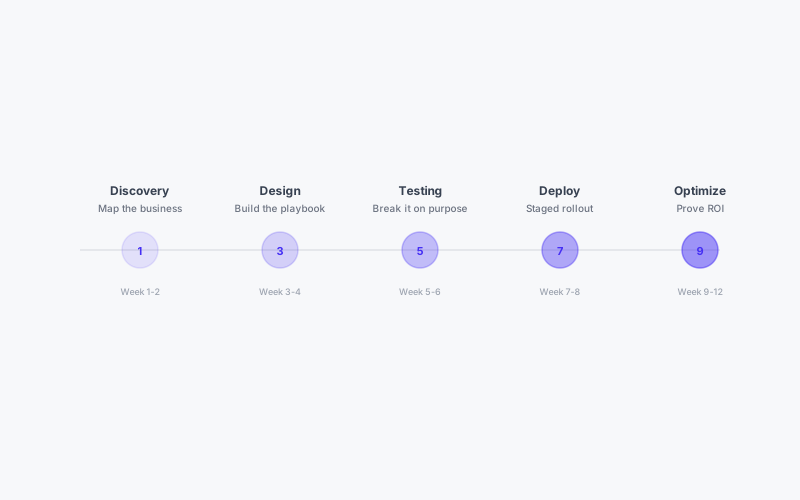
Agencies that offered chatbot setup two years ago are evolving into full agentic systems practices. The scope of work has expanded from "build a bot" to a comprehensive, ongoing engagement: behavioral design, knowledge architecture, integration, channel strategy, testing, monitoring, and continuous optimization.
And crucially, this is recurring, high-value work — not a one-time project. Agents need continuous tuning as the business changes, products evolve, customer expectations shift, and new edge cases surface. The initial deployment is just the beginning. The ongoing management is where the long-term value lives — for the client and for the consultant.
The consultants who are moving earliest are building proprietary methodologies, establishing credibility, and locking in clients before the market gets crowded. They're not waiting for the industry to formalize this role. They're defining it.
What Separates a Real Platform from a Toy
If you're evaluating where to build this practice, here's what to look for in a platform. Not features for features' sake, but capabilities that map to the layers described above:
- Deterministic behavioral controls — not just prompts, but structured rules with interaction logic: dependencies, priorities, conditional activation, criticality levels
- Version control — the ability to preview changes, release snapshots, and roll back without disrupting live conversations
- Testing infrastructure — automated test suites, scenario generation, regression testing, draft mode for safe iteration
- Multi-channel native — one behavioral brain with channel-specific delivery, not separate bots duct-taped together
- Deep integration layer — real tool execution with contextual controls, not just data retrieval
- Built-in analytics — conversation KPIs, revenue attribution, smart classification, per-agent performance breakdowns
- Knowledge management — hybrid search, multi-source ingestion, contextual chunking, freshness management
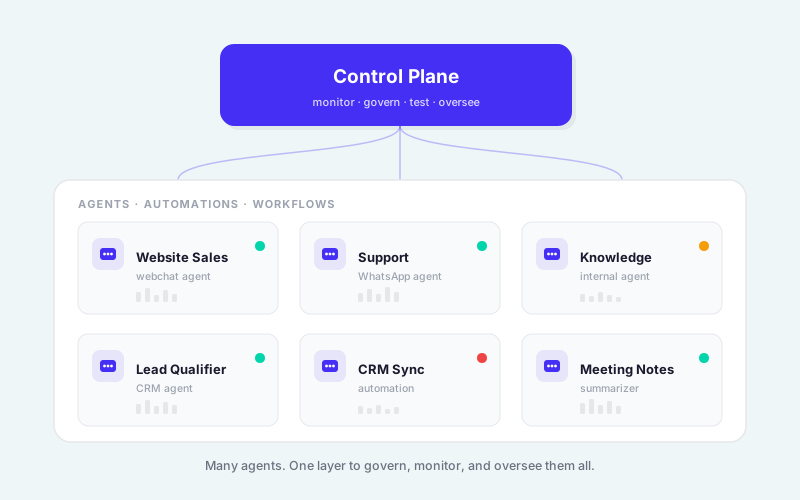
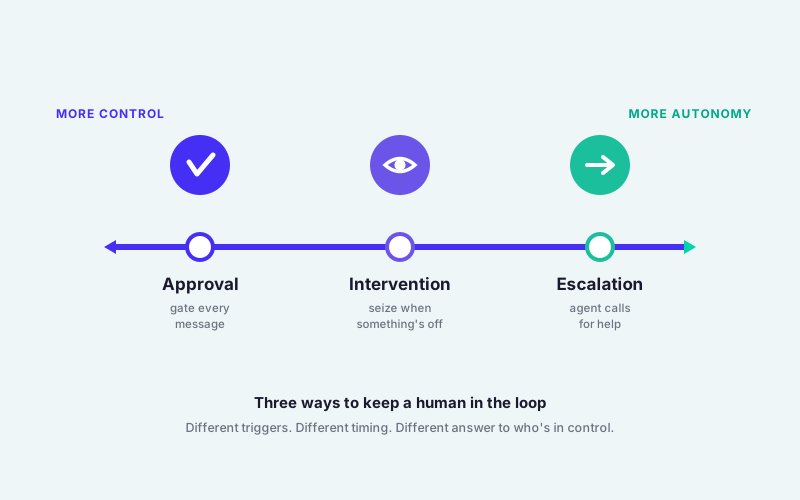
- Human oversight — real-time intervention, escalation paths, conversation monitoring
If a platform is missing any of these, you'll end up building them yourself — which defeats the purpose of having a platform.
The Window Is Open
Every major enterprise platform shift has created its own consulting ecosystem. ERP had its consultants. Cloud had its architects. Marketing automation had its specialists. The pattern is consistent and predictable: the technology arrives, early adopters struggle, and a class of experts emerges to bridge the gap.
Agentic systems are following the same pattern — but faster, because the technology is more capable and the stakes are higher. An AI agent isn't a backend system that employees use internally. It's a public-facing representative of the business, having real conversations with real customers, making real commitments.
The companies deploying these agents aren't the ones who will master them. That gap is your opportunity. The question isn't whether agentic systems experts will exist — it's whether you'll be one of the first.