"Human in the loop" is the phrase that ends the hard conversation. A prospect worries the AI will say something wrong, someone reassures them that there's always a human in the loop, everyone relaxes, and the meeting moves on. It works like a checkbox: present or absent, yes or no, reassuring either way.
But it isn't one thing. The phrase collapses at least three genuinely different mechanics, each with its own trigger, its own timing, and its own answer to the only question that matters — who is actually in control of this conversation right now. A platform can offer one of them and none of the others. A single deployment can need all three for different agents. And "do you support human in the loop?" is close to a meaningless question, because the useful one is: which kind, triggered by whom, and at what moment.
The three are escalation, intervention, and approval. They are not interchangeable, and treating them as one undifferentiated feature is how teams end up with the comforting noise of oversight without the substance of it.
The Axis That Separates Them
Before the definitions, the distinction. The three mechanics differ on two axes, and once you see them on those axes they stop blurring together.
The first axis is who initiates. Does the agent decide a human is needed, or does a human decide to step in, or is the human's involvement a standing rule that fires automatically every time?
The second axis is granularity and timing. Is the human handling an entire conversation, seizing one in progress, or vetting a single message before it goes out?
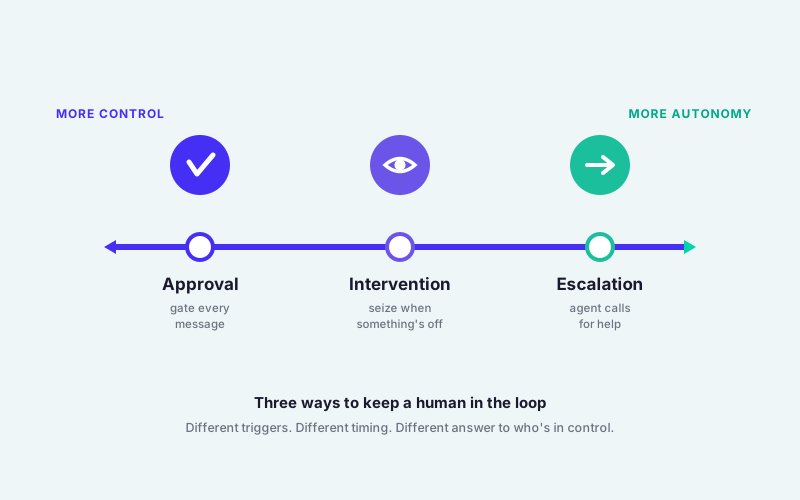
Escalation is the agent handing off a whole conversation when it recognizes its own limits. Intervention is a human seizing a conversation in progress because something looks wrong. Approval is a standing gate where the agent drafts a response and waits for a human to release it before anything reaches the customer. Same family. Three different shapes.
Escalation: The Agent Knows Its Limits
Escalation is agent-initiated and conversation-level. The agent is handling a conversation, recognizes it has hit a wall — a refund outside policy, a sensitive complaint, a question it has no grounds to answer — and hands the whole thing to a human, with context.
The trigger lives in the agent's behavioral design. Good escalation isn't a single rule; it's a set of conditions that weigh the financial stakes, the topic sensitivity, the customer's emotional state, and the agent's own confidence. A billing dispute over fifty dollars might be fine to handle. The same dispute over five thousand, with a customer who has been waiting a week, is not. The rules should know the difference, and the handoff should carry everything the human needs — the full history, what the agent understood, what it already tried — not dump them into a blank screen with "a customer needs help."
Here is the honest wrinkle: escalation is the one mechanic where the human doesn't supervise the agent so much as replace it. The agent leaves the loop. The human owns the conversation from that point. If you want to be precise, escalation is a handoff, not supervision — which is exactly why it can't be the only form of oversight you have. It only fires when the agent is self-aware enough to know it's stuck. The dangerous failures are the ones where the agent is confidently wrong and never raises its hand at all.
Intervention: The Human Is Watching
Intervention is human-initiated and conversation-level. The agent thinks it's doing fine. A monitoring layer — watching for human-defined conditions, classifying conversations in real time, surfacing the ones that warrant a closer look — flags a conversation, and a human decides to disengage the AI and take over.
This is the answer to the failure escalation can't catch: the agent that doesn't know it's in trouble. The agent improvised an answer with no knowledge-base hit. Sentiment shifted negative three messages ago. The customer has asked the same question twice. None of these trip an escalation rule, because from the agent's point of view nothing is wrong. They trip a human watching the right signals.
Intervention is the emergency brake, and it depends on infrastructure most platforms don't have: a live view of active conversations rather than a log you read tomorrow, the ability to pause the agent's next response and seize the thread mid-stream, and for that to work identically across every channel — webchat, WhatsApp, email, voice. A human reviewing transcripts after the fact is not intervention. By then the message has shipped and the moment to act has passed.
The key property: intervention is exception-handling, initiated by the supervisor, on a conversation the agent was otherwise running autonomously. The human is trusting the agent to run — and watching closely enough to override it.
Approval: Nothing Ships Without a Yes
Approval is the newest of the three, and the one that breaks the pattern. It is configuration-driven and message-level. When an agent is set to require approval, it does the work — reads the conversation, drafts the response, prepares the action — and then stops. The draft waits for a human to review it, edit it, and release it. Nothing reaches the customer until someone says yes.
What makes approval categorically different from the other two is that it is pre-emptive and default-on. Escalation and intervention are exception-handling: they fire when something goes wrong, on conversations the agent is otherwise running by itself. Approval is a standing posture. The agent never sends autonomously at all — not because something went wrong, but because that's the rule for this agent. It's the difference between a safety net and a leash.
This is the right setting in specific situations, and recognizing them is part of the craft. A brand-new agent in its first weeks of production, where nobody trusts it to send unsupervised yet. A high-stakes channel or topic where a wrong message is expensive enough that the latency of human review is worth paying on every single response. A regulated context where a human must sign off on outbound communication as a matter of compliance, not preference. In all of these, the human isn't catching exceptions — they're vetting everything, by design, and editing the agent's drafts into the final word.
Approval also doubles as the best training instrument you have. A human editing drafts all day is generating a stream of corrections — this phrasing, not that; this is the line we don't cross; here's what was missing. That's not just oversight. It's a feedback signal you can mine to improve the agent's behavioral design until it has earned the right to a looser setting.
A Spectrum, Not a Checkbox
Lined up, the three mechanics form a spectrum of control versus autonomy.
At the controlling end sits approval: gate every message. You don't trust the agent to send unsupervised, so it doesn't. In the middle sits intervention: let it run, but watch, and seize the thread when something looks off. At the autonomous end sits escalation: trust the agent to do the work and to know its own limits, stepping in only when it asks. (There's an even looser fourth posture some teams use — pure after-the-fact review, where humans read completed conversations and change nothing in real time. It's the weakest form of oversight, and on its own it's barely oversight at all.)
The mistake is treating these as a single capability a platform either has or lacks. The real questions are sharper. Where on this spectrum should this specific agent sit, for this use case, on this channel, today? And what moves it?
Because the position isn't fixed. A well-run deployment moves an agent along the spectrum as trust accrues. It launches on approval — every message vetted, every correction feeding back into the design. As the drafts need less editing and the test suite hardens, it graduates to running autonomously with intervention available and escalation rules in place. The mechanics that were a leash in week one become a safety net in month three. That progression is a deliberate decision, made per agent, not a default you accept because it's what the platform happened to ship.
Why This Is the Practice, Not a Feature
For consultants and agencies building on agentic platforms, this is the part of the work that doesn't fit in a demo. Choosing the oversight posture for each agent — and the criteria that let it graduate to the next one — is a design decision with real consequences. Set approval on an agent that handles thousands of routine conversations a day and you've built a bottleneck nobody can staff. Leave a brand-new agent on escalation-only and you've trusted it to know limits it hasn't learned yet. The agent that confidently ships a wrong refund policy on day two is the one whose approval gate you removed too early.
The deeper point is that "human in the loop" was never a yes-or-no property of a platform. It's a set of distinct mechanics, each suited to a different level of trust, and the expertise is in knowing which one a given agent needs right now and what has to be true before it earns the next. The platforms that only offer one of the three force every agent into the same posture. The ones that offer all three turn oversight into a dial you can actually turn.
A client who asks "is there a human in the loop?" is asking the wrong question, and the consultant who can explain why — and then design the right posture for each of their agents — is the one who gets to keep the account.