Every AI agent, no matter how well-configured, will eventually get it wrong. It will misread a customer's intent. It will give an answer that's technically correct but contextually wrong. It will handle a sensitive situation with the wrong tone. It will confidently take an action it shouldn't have.
This isn't a failure of the technology. It's the nature of deploying autonomous systems in unpredictable environments. The question isn't whether your agent will fail. It's whether you'll know when it happens, whether you can intervene before damage is done, and whether you can prevent it from happening the same way again.
Most teams plan for the happy path. The best teams design for failure.
The Four Failure Modes
Agent failures aren't random. They cluster into three categories, and each requires a different response infrastructure.
Silent Failures
The agent gives a wrong answer and neither the agent nor the customer flags it. The customer leaves with incorrect information — maybe a wrong return policy, a feature that doesn't exist, or a price that isn't current. Nobody knows anything went wrong until the customer comes back angry, or worse, doesn't come back at all.
Silent failures are the most dangerous because they're invisible. They don't trigger alerts. They don't show up in error logs. They look like normal conversations. The only way to catch them is systematic monitoring — not reviewing every conversation, but classifying them automatically and surfacing the ones that need attention.
This is where smart tagging becomes essential. Every conversation should be automatically classified: by topic, by sentiment, by outcome, by whether the agent used its knowledge base or improvised, by whether the customer's question was actually resolved or just deflected. When you can filter conversations by these dimensions, silent failures become visible.
A tag like "agent improvised answer — no knowledge base hit" is a red flag worth investigating. "Customer asked same question twice in one conversation" is another. "Sentiment shifted negative after agent response" is a third. None of these are definitive proof of failure, but they're the signals that let you find failures you wouldn't otherwise see.
Escalation Failures
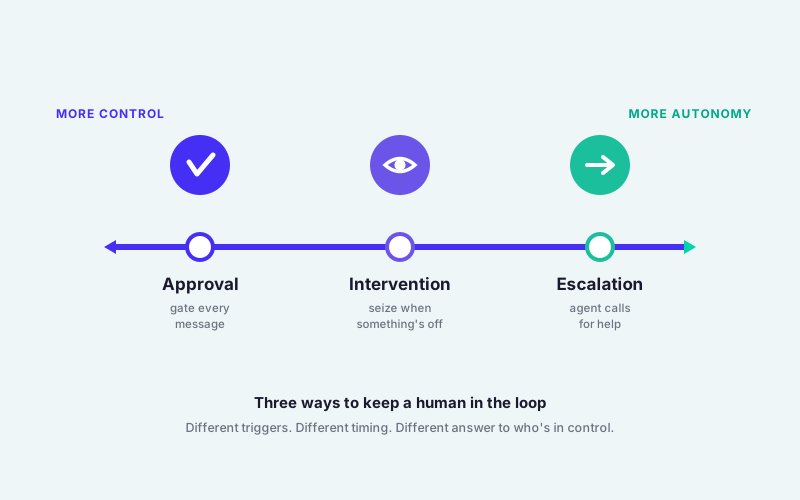
The agent recognizes it's out of its depth but handles the handoff poorly. Maybe it escalates too late — after the customer is already frustrated. Maybe it escalates without context, forcing the customer to repeat everything. Maybe it escalates to the wrong team. Or maybe it doesn't escalate at all, looping in circles trying to help when it should have stepped aside three messages ago.
Good escalation isn't a single trigger. It's a system of behavioral rules that account for different scenarios. A billing dispute over $50 might be fine for the agent to handle. A billing dispute over $5,000 with a customer who's been waiting a week? That needs a human, immediately, with full context.
The escalation rules need to consider the customer's emotional state, the financial stakes, the topic sensitivity, the agent's confidence in its own answers, and the conversation history. A customer who says "this is unacceptable" after two calm exchanges is in a different situation than one who opens with "this is unacceptable." The rules should know the difference.
And when escalation does happen, the handoff quality determines whether you save the situation or make it worse. The human who takes over needs the full conversation history, the agent's understanding of the issue, what actions were already taken, and what the customer is actually asking for. Dumping them into a blank screen with "a customer needs help" is barely better than no escalation at all.
Action Failures
The agent says "Done — I've booked your appointment for Thursday at 2pm." The customer thanks it and leaves. But the calendar API returned a 500 error, and the booking never actually happened. The customer shows up to a meeting that doesn't exist.
Or the agent confirms "I've updated your shipping address" — but the CRM write failed silently, and the package ships to the old address. Or it says "I've sent the invitation to your team" but the email service was rate-limited and nothing went out.
Action failures are uniquely dangerous because the agent genuinely believes it completed the task. It received a tool call instruction, it executed it, and from its perspective the job is done. It doesn't know the downstream system didn't follow through. So it confirms success to the customer with full confidence.
Catching these requires tool execution monitoring — not just logging that a tool was called, but verifying it succeeded, tracking what it returned, and flagging cases where the agent confirmed an action whose underlying API call failed or returned an unexpected result. When your agent has 20+ tool integrations — calendar, CRM, email, order management, document retrieval, payment processing — every one of them is a potential point of silent failure.
The operational discipline here is treating tool calls as first-class events in your monitoring stack, not just appendages to the conversation. Every tool call should be logged with its input, output, and status. Failures should trigger alerts. And the agent's behavioral rules should account for failure cases — "if the booking fails, tell the customer and offer to try again" rather than assuming every API call succeeds.
Behavioral Drift
The agent works fine for weeks, then gradually starts behaving differently. Not catastrophically — just slightly off. Responses get longer. Tone shifts. It starts offering solutions it wasn't trained to offer. It handles edge cases differently than it used to.
Behavioral drift happens when the underlying conditions change — customer questions shift, knowledge base content gets updated, or upstream model changes alter response patterns — but the behavioral rules haven't been adjusted to match.
Catching drift requires baseline metrics that you track over time. If your average response length increases by 40% over two weeks, something changed. If the distribution of smart tags shifts — suddenly more conversations tagged "confused customer" — something changed. If the escalation rate drops to near zero, that's probably not a good sign — it might mean the agent stopped recognizing when it's out of its depth.
The fix isn't reacting to drift after it happens. It's versioning your behavioral configuration so you can compare current performance against a known-good baseline, and rolling back when something degrades.
Intervention: The Emergency Brake
Sometimes you need to step in mid-conversation. Not after the conversation ends. Not on the next conversation. Right now, while the customer is still engaged.
Real-time intervention means a human can take over an active conversation at any point. The agent steps aside, the human takes control, and the customer experiences a seamless transition — ideally without even knowing there was a handoff.
This requires infrastructure that most platforms don't have. You need real-time visibility into active conversations — not a log you review later, but a live feed. You need the ability to flag a conversation for takeover and have the system pause the agent's next response until a human confirms or overrides. And you need this to work across channels — the same intervention capability whether the conversation is happening on WhatsApp, email, webchat, or phone.
Intervention isn't a sign that your AI is bad. It's a sign that your oversight system is working. The alternative — letting the agent continue when it shouldn't — is always worse.
The Monitoring Stack
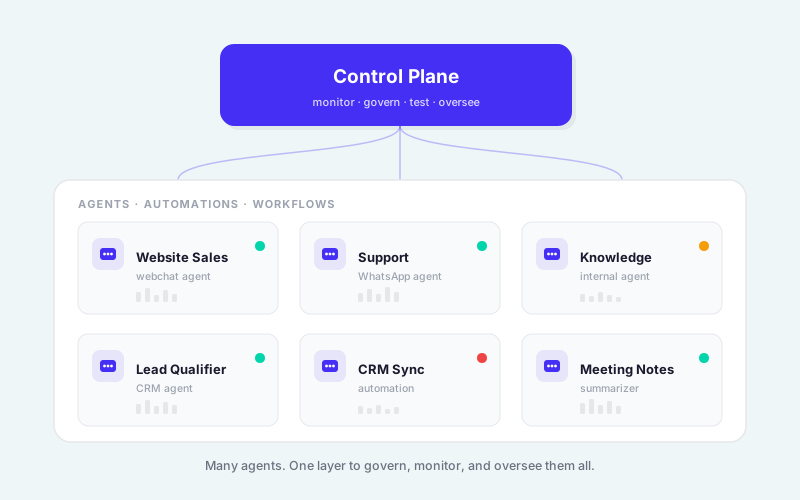
Production agent oversight isn't one tool. It's a stack of complementary capabilities:
Automatic conversation classification: Every conversation tagged by topic, outcome, sentiment, and behavioral patterns. This is your early warning system for silent failures and drift.
Real-time conversation feed: Live view of active conversations with the ability to filter, sort, and prioritize. Not a firehose — a dashboard that surfaces the conversations most likely to need attention.
Intervention controls: The ability to take over any active conversation, with full context, across any channel. The emergency brake you hope to rarely use but always need available.
Performance analytics: Resolution rates, escalation rates, response quality, customer satisfaction — tracked per agent, per channel, per topic, over time. This is how you spot drift before it becomes a problem.
Behavioral versioning: The ability to snapshot your agent's behavioral configuration, compare current performance against previous versions, and roll back changes that degraded quality. Without this, every optimization is a gamble you can't undo.
Designing for Recovery
The best agent deployments aren't the ones with the lowest failure rate. They're the ones with the fastest recovery time.
When a failure happens — and it will — how quickly can you identify it? How quickly can you intervene? How quickly can you diagnose the root cause? How quickly can you deploy a fix? And how confident are you that the fix doesn't break something else?
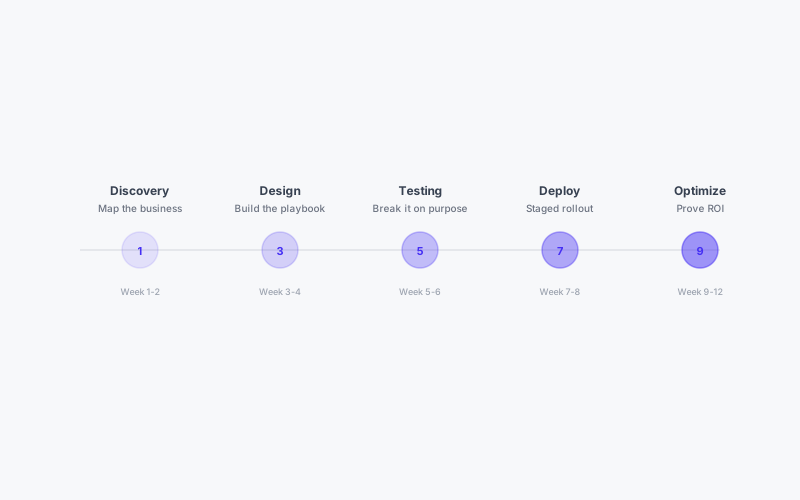
This is why testing infrastructure matters as much as monitoring. When you identify a failure pattern, you need to reproduce it in a test scenario, verify your fix addresses it, and run regression tests to confirm nothing else broke. Then you deploy the fix to a draft version, validate it against your test suite, and only then release it to production.
This loop — detect, intervene, diagnose, fix, test, release — is the operational rhythm of a well-run agent deployment. It's not glamorous. It's not "set it and forget it." It's ongoing, disciplined work. And it's the reason agent deployments need dedicated expertise, not just an initial setup.
The Uncomfortable Truth
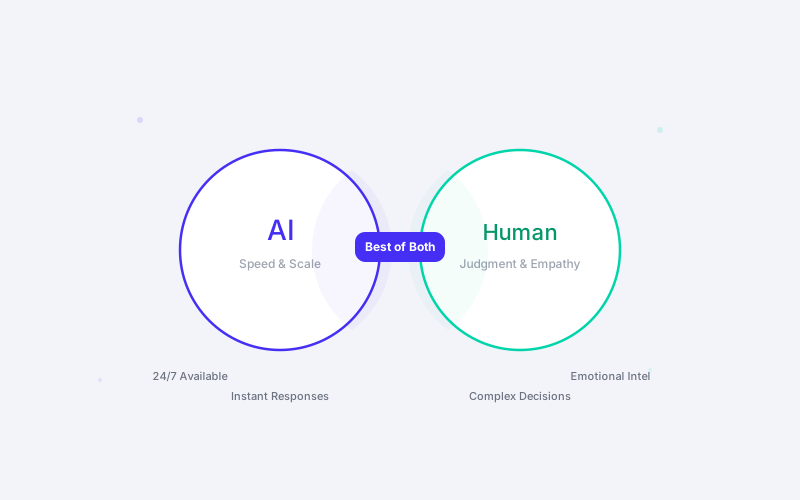
Full automation is a myth in customer-facing AI. Every production system that works reliably has humans behind the scenes — monitoring, intervening, tuning, testing. The AI handles the volume. The humans handle the judgment.
The question isn't whether you need humans in the loop. It's whether your infrastructure makes their involvement effective. A human reviewing conversation logs from yesterday is too late. A human watching a real-time feed with smart classification, intervention controls, and behavioral versioning? That's an oversight system that actually works.
Plan for failure. Build for recovery. The agents that earn trust are the ones backed by infrastructure that catches problems before customers do.