You've deployed an AI agent for a client. It's handling conversations, resolving issues, qualifying leads. The client's team is impressed. But when the quarterly business review comes around, the person across the table isn't the team lead who watches the conversations — it's the VP or CEO who approved the budget. And they have one question: "What's this doing for us?"
"The agent is handling a lot of conversations" isn't an answer. "Customer feedback has been positive" isn't an answer. These are inputs, not outcomes. The person who controls the budget thinks in revenue, cost, and efficiency. If you can't translate agent performance into those terms, the engagement is at risk — no matter how well the agent works.
This is the gap that separates consultants who deploy agents from consultants who retain clients. Deployment is a project. Proving value is a practice.
The Metrics That Actually Matter
Forget vanity metrics. "Number of conversations handled" tells leadership nothing about business impact. Here are the metrics that make executives pay attention, organized by what they prove.
Cost Displacement
The most straightforward story: the agent is doing work that used to require paid humans.
Calculate cost per conversation before and after deployment. Before: total support costs divided by total conversations. After: platform costs plus remaining human agent costs divided by total conversations. The delta is your cost displacement.
But the naive version of this metric is misleading. If the agent handles the easy conversations and humans still handle the hard ones, you haven't displaced cost — you've just cherry-picked the cheap tickets. The honest metric segments by complexity: what's the cost per conversation for issues the agent resolves autonomously versus issues that require escalation versus issues the agent handles partially before handing off?
The most compelling version of this metric is resolution-adjusted cost. Not just "the agent had a conversation" but "the agent resolved an issue that would have required a human, end to end, with no escalation." That's real displacement.
Revenue Attribution
This is where most agent deployments leave money on the table — not in missed revenue, but in unmeasured revenue. The agent qualifies leads, books meetings, recovers abandoned carts, and upsells existing customers. But if you're not tracking which revenue traces back to agent-initiated or agent-assisted conversations, you can't prove it.
Revenue attribution requires connecting conversation outcomes to downstream business events. The agent qualified a lead and booked a demo — did that demo convert? The agent re-engaged a lapsed customer — did they purchase again? The agent handled a support issue for a customer who was considering canceling — did they stay?
This means your analytics need to track the full journey, not just the conversation. Tag conversations with outcomes — "meeting booked," "issue resolved," "upsell offered" — and then follow those tags downstream into your pipeline or order system. The attribution doesn't need to be perfect. It needs to be credible enough that a CEO can see the connection between agent activity and revenue movement.
Per-Agent Performance
If a client has multiple agents — one for sales, one for support, one for onboarding — lumping their metrics together hides the story. The sales agent might be crushing it while the support agent is struggling. Blended numbers make both look mediocre.
Per-agent breakdowns let you show which agents are delivering value and which need optimization. This is also how you justify expanding the engagement: "Your sales agent is generating $X in attributed pipeline per month. Let's deploy the same approach for customer success."
Conversation Intelligence
Raw numbers tell leadership what happened. Conversation intelligence tells them why.
Automatic conversation classification — by topic, sentiment, outcome, escalation reason — turns your conversation data into a diagnostic tool. When you can tell a CEO "34% of support conversations are about shipping delays, up from 22% last month — that's a fulfillment problem, not an agent problem," you've moved from reporting metrics to providing strategic insight.
Smart tagging also surfaces opportunities. If the agent is fielding a surge of questions about a feature the client doesn't offer yet, that's product intelligence. If sentiment scores drop on a specific topic, that's an early warning for a bigger issue. The agent becomes a sensor, not just a responder.
The Review Framework
Don't dump 30 metrics into a slide deck. Structure your business reviews around three questions executives actually care about:
"Is it saving us money?" — Cost displacement metrics. Resolution-adjusted cost per conversation. Human hours freed. Show the trend line, not just the current number.
"Is it making us money?" — Revenue attribution. Pipeline generated. Meetings booked. Upsells completed. Show the connection between agent activity and revenue, even if the attribution is approximate.
"What are we learning?" — Conversation intelligence. Topic distribution shifts. Emerging issues. Customer sentiment trends. This is what makes the CEO see the agent as a strategic asset, not just an operational tool.
One page per question. No filler. If you can't fit the story on three pages, you're measuring too many things and saying too little.
The Timing Trap
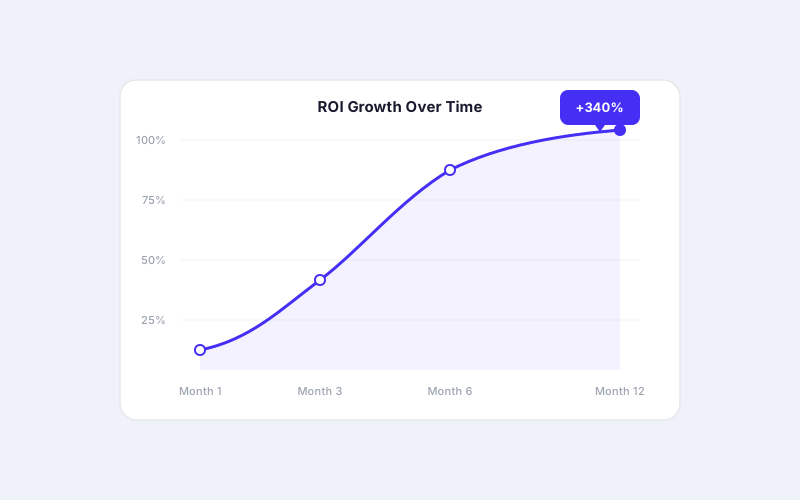
Agent ROI follows a curve. Month one is setup and calibration — costs are high, impact is low. Month two the agent is handling real conversations but still being tuned. Month three you start seeing reliable patterns. Month four and beyond is where the compounding happens — the agent improves, edge cases get covered, and the metrics accelerate.
If you let a client evaluate ROI in month one, they'll see cost with no return. Set expectations at the start: here's what we'll measure, here's the timeline, here's when we'll have enough data to tell the real story. Get agreement on the evaluation framework before deployment, not after.
The consultants who lose clients at renewal aren't the ones with bad agents. They're the ones who never set up the measurement infrastructure to prove the agent's value. By the time they scramble to build a case, the budget review has already happened.
Measurement as a Service
Here's the part most consultants miss: measurement isn't a one-time report. It's an ongoing service that clients will pay for.
Monthly business reviews. Quarterly deep dives. Anomaly alerts when metrics shift unexpectedly. Optimization recommendations based on what the data shows. This is recurring, high-value work that directly ties your engagement to business outcomes — making you very hard to replace.
The agent is the product. The measurement is the relationship. Build both.