Spend a day inside almost any company that's been adopting AI and you'll notice the same thing — agents everywhere, and no one who can tell you how they're all doing.
There's the customer-facing agent on the website handling sales questions. The support agent on WhatsApp. An internal one that surfaces company knowledge for employees. One that qualifies inbound leads and writes them into the CRM. One that summarizes every meeting. A couple that someone wired together in Claude Code over a weekend. And then whatever the existing vendors quietly switched on inside the tools the company already pays for — because every SaaS product now ships its own agent whether anyone asked for it or not.
That's just the agents. Around them is a second layer that's been accumulating for longer: the n8n flows, the Zapier zaps, the AI-powered CRM workflows, the Slack bots, the email sequences, the webhook chains. The script someone wrote on a Friday afternoon that now sits in the middle of a customer-facing process, and nobody quite remembers writing.
Every one of these was a reasonable idea on the day it shipped. Collectively, they're something most companies have not named yet — and definitely haven't planned for.
Nobody Decided On This
Sprawl doesn't arrive as a decision. It arrives as a series of small, individually sensible yeses.
The support team had a backlog, so they deployed an agent. Marketing wanted faster lead routing, so they built a workflow. An engineer noticed a repetitive task and automated it in an afternoon. A vendor pushed an update, and now there's an AI assistant in the billing tool. None of these required a meeting. None of them were wrong. And none of them were designed to coexist with the other forty.
So you end up with a collection, not a system. Different interfaces. Different logs, where there are logs at all. Different owners, some of whom have left the company. Different permission models. Different failure modes. Different levels of quality, from carefully tested to "it worked in the demo." The CRM-update workflow doesn't know the lead-qualification agent exists. The meeting summarizer and the knowledge agent are reading from the same documents, and neither knows it.
It looks like automation. Structurally, it's closer to operational spaghetti — and the company is now running real customer-facing processes through it.
The Questions Nobody Can Answer
Here's the test. Pick a company that's been deploying agents and automations for a year, and ask whoever's responsible a few plain questions.
How many agents and automations are running right now? Most can't produce the number.
Which ones are actually being used, and how often? Which are quietly idle — still holding permissions, still capable of firing?
Are they helping? Not "did the project launch" — is the support agent resolving issues, or just deflecting them onto a customer who comes back angrier?
Are any of them hallucinating? A public-facing agent that confidently invents a return policy doesn't throw an error. It produces a fluent, wrong answer, and unless someone is systematically checking, nobody finds out until a customer does.
Are they duplicating work? Two agents, built by two teams, doing overlapping things slightly differently — which is worse than either doing it alone, because now the company gives two answers to the same question.
Are they triggering downstream problems? One automation updates a CRM field. A second watches that field and fires outreach. A third syncs the record to billing. Change the first and you've changed all three — and the person making the change has no idea the chain exists.
None of these questions is exotic. They're the questions you'd ask about any other part of the business. The reason they're hard to answer for agents is simple: the agents were deployed faster than the ability to see them was built.
The Countdown You Can't Hear
The dangerous thing about an ungoverned agent stack isn't that it fails loudly. It's that it doesn't.
A workflow that breaks throws an error someone eventually notices. A workflow that's subtly wrong — escalating the wrong cases, sending follow-ups to people who asked to be left alone, writing slightly incorrect data into the CRM every day — does its damage quietly, and the cost compounds while everyone's attention is on the next launch.
That's the real exposure. Not one agent embarrassing the brand once, in public, where you'd at least see it happen. The exposure is that somewhere in a stack of forty automations nobody has fully mapped, something has been wrong for three months — and the first real signal will be a customer, a regulator, or a metric that's finally drifted far enough to get noticed.
You can't manage what you can't see. Most companies deploying agents right now cannot see their own stack.
The Next Phase Is Control, Not Deployment
The last two years of AI adoption were about capability: can an agent do this at all? The answer turned out to be yes, often — and that question is largely settled. Deploying an agent is no longer the hard part. In a lot of companies it's now the easy part. Arguably too easy.
The next phase won't be won by whoever ships the most agents. It'll be won by whoever can actually run them.
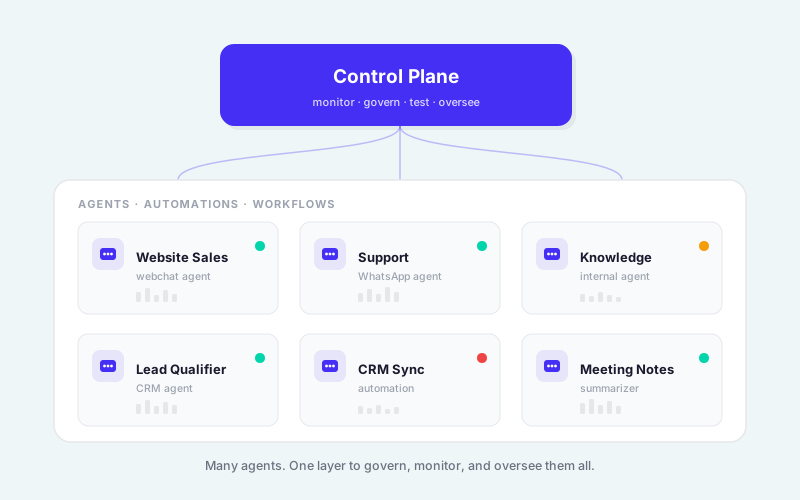
That shifts the center of gravity from building agents to operating them — a layer that sits above the individual agents and automations and gives a company one place to see and govern the whole fleet. Infrastructure teams have a name for this: the control plane. The individual workers do the work; a single layer knows what exists, what each is allowed to do, how it's performing, and when a human needs to step in.
Most companies don't have this layer. They have a pile of tools and a vague sense of unease.
What an AI Operations Platform Actually Needs
If the next phase is operating agents rather than just launching them, it's worth being specific about what that takes. The layer that turns a pile of agents into a managed fleet has a real job description — and "we have a dashboard" doesn't cover it.
It needs to deploy many kinds of agents, across channels and departments, from one place — public-facing sales and support, internal knowledge and HR, lead qualification, back-office automation — instead of one agent per vendor per silo.
It needs centralized monitoring: a single view of every agent and automation, what it's doing, how often, and whether the trend is healthy. The number of running agents should not be a mystery.
It needs governance and permissions: explicit control over what each agent may do, what it may access, and what it must never do — applied consistently, not reinvented in every tool.
It needs testing and versioning: a way to verify behavior before it ships and after every change, so an optimization to one agent doesn't quietly break it. Testing a single agent is already its own discipline. Across a fleet, skipping it isn't an option.
It needs analytics that measure outcomes, not activity — resolution, escalation, revenue, cost — so "are they helping?" has an answer backed by numbers instead of vibes.
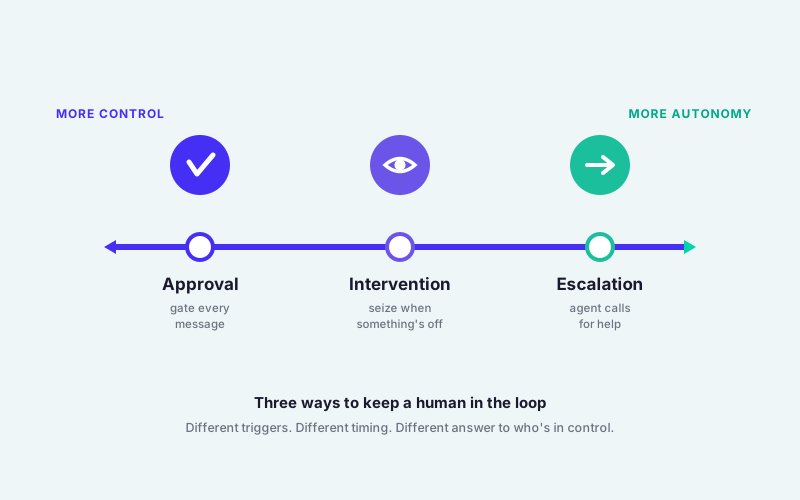
It needs escalation paths and human oversight: a defined way for any agent, on any channel, to hand off to a person — and for a person to step into any conversation already in progress.
It needs an audit trail: a record of what every agent did and why, so when something goes wrong you can trace it instead of guessing.
Notice that almost none of this is about making agents smarter. It's about making them accountable. That's the part the market has under-built, because accountability is less exciting than capability — and it only looks obviously necessary once the sprawl is already there.
This is the layer NForce is built to be. Not another agent to add to the pile — the platform the pile is supposed to run on: many agents, many channels, many departments, with one place to govern, monitor, test, and oversee them.
The Opportunity
For consultants and agencies, read this as a forecast.
The first wave of AI services work was deployment: help a client launch an agent. That work isn't disappearing, but it's commoditizing — the platforms keep getting easier, and "we built you a bot" is a less impressive sentence every quarter.
The second wave is operations. Companies that spent a year saying yes to agents are going to wake up to a stack they can't see and can't govern, and they will need someone to bring order to it: inventory what's running, retire what isn't helping, consolidate the duplicates, wrap monitoring and permissions and escalation around what remains, and operate it as a managed fleet instead of a pile.
That's a bigger engagement than a deployment, and a stickier one. It's recurring by nature. And it's available to whoever sees it coming first.
The companies that win the agent era won't be the ones that deployed fastest. Most are already past that point — they have plenty of agents. The winners will be the ones that can answer, at any moment, what all those agents are doing and whether it's working.
Most are closer to needing that answer than they think.